
The Chaos Theory of Burning
The Chaos Theory of burning
Burn Unit 9
Written by: Paxton Caroline Hayes
Photos taken by: Paxton Caroline Hayes
Location: Sandhills WMA in Taylor County, GA
Becoming Comfortable With Chaos
When I first learned about chaos theory from Dr. Ian Malcom (played by Jeff Goldblum), I was five years old and watching a 10-year anniversary re-run of Jurassic Park with my mom. “Life uhh… finds a way,” he said to a room full of scientists who believed they could predict everything. To their horror, he was right, about the water droplets and the dinosaurs, and I have spent every day since intrigued by the apparent randomness of chaotic, complex systems. I could never see or understand the mathematics of chaos theory. But I find those same underlying patterns, interconnectedness, and constant feedback loops fascinating in nature.
Fire behavior is predictable, until it’s not. You can have the best burn plan written down and the fire doesn’t do anything that you predicted on the page. You can use weather models and environmental data to pick the best day to light your fire and the fuels won’t burn. Just like the scientists had to get comfortable with the dinosaurs in Jurassic Park, firelighters have to become comfortable with the unknown that is inherent in prescribed fire.
To become comfortable with the chaos, you have to be prepared for every outcome possible.
Weather and the Environment
The two most chaotic underlying factors in prescribed fire are weather and the environment. Models and data can tell you 90% of the story, but there is no way to know for sure how they will interact on the day of the burn. Fuels absorb different amounts of water, soils drain moisture at different rates, relative humidity and wind speeds can change in an instant. Each technical aspect of burning has expected ranges and coinciding fire behavior that can help you make decisions prior to the fire and know how best to prepare for your burn. But nature doesn’t exist on a clean textbook page with round numbers, and every tiny difference in initial conditions can result in widely diverging outcomes.
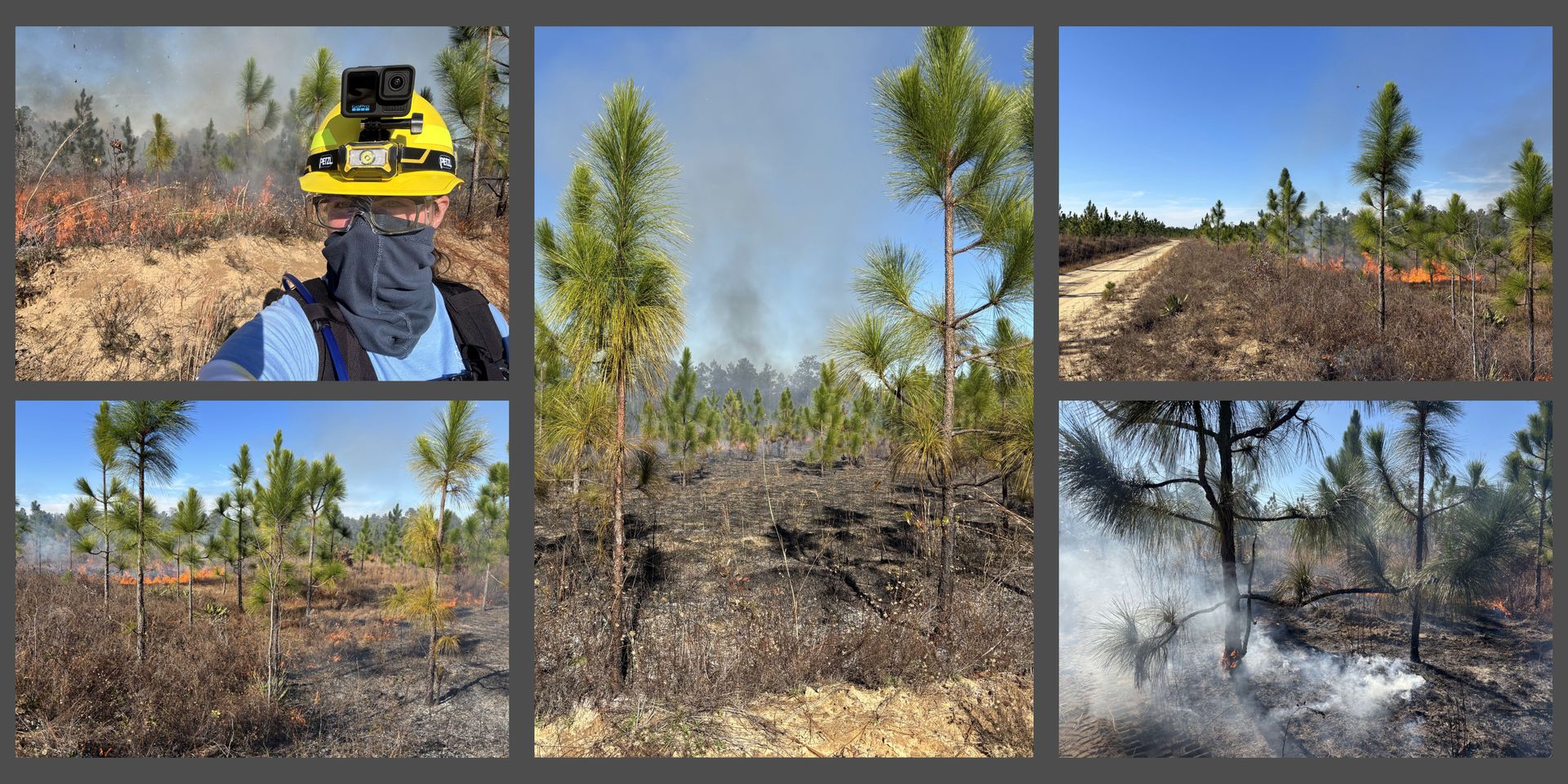
This chaos was at the forefront of my mind when I was participating in a Learn and Burn at the Sandhills WMA in Taylor County at the beginning of December. The area is dominated by sandy, clay-rich soils and hilly, scrub-pine habitat. When I arrived at 8:00am, I wasn’t convinced that anything would burn. The ground was wet with frost, the fine fuels were loaded with moisture, and it had rained an inch and a half the morning before so the soil was damp. It was right at freezing temperatures, deeply overcast, and the too-slow winds were frigid and unpredictable in direction.
But right before noon the sun came out and the winds, while still unpredictable, gained strength. An hour later we lit our test fire, and to my surprise, it took on the first try. Our 33 acres were successfully burned within a couple of hours. Why? Because small changes that we hadn’t anticipated in the weather and environment created conditions more suitable for prescribed fire.
That day, the chaos was in our favor. On other burns, that chaos is not. And above all else, you have to stay alert on burns because the chaos is happening all around you.
Respecting the Chaos
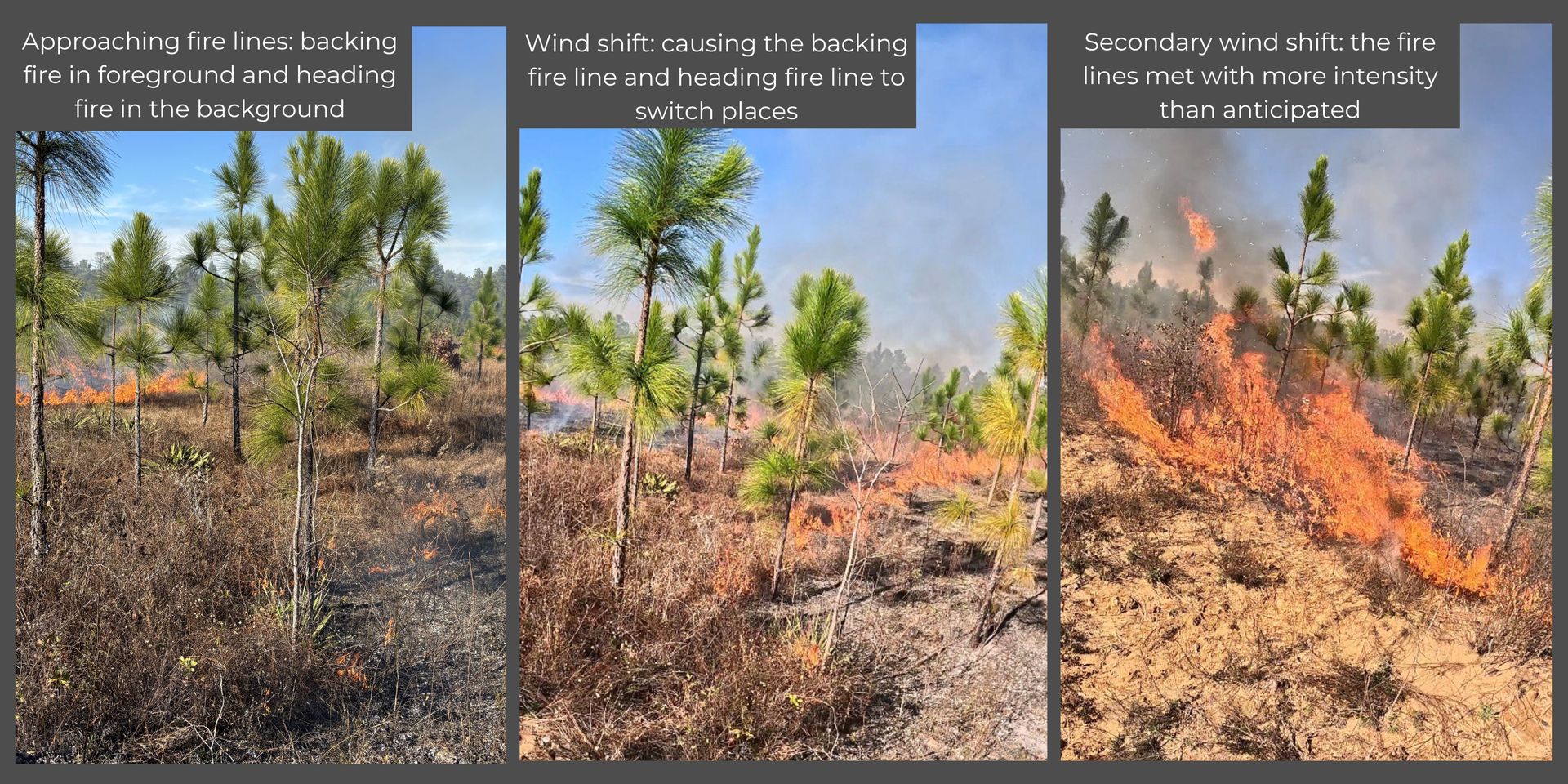
When you are on the fire line, you have to always be paying attention. Small changes in any weather or environmental factor, such as wind direction or fuel moisture, can change the fire behavior drastically. During the Sandhills WMA burn, I was able to catch an example of this chaos on camera.
After letting the backing fire move through around a third of the burn plot, it was decided that we needed to increase our fire intensity for the interior of the plot to burn more cleanly. An interior fire line was dropped about 30 feet ahead of the backing fire. This created an opportunity for the heading fire to burn more intensely, but it would burn out on its own when it met the backing fire and already-burned fuels. But the wind unexpectedly shifted, causing the backing fire line and heading fire line to switch places, and the heading fire to grow faster than expected. As the two lines were converging, the wind shifted a second time, moving the fire towards a patch of heavier fuels near where I was standing.
In moments, what should have been a quiet merging of lines turned into four foot flames moving straight towards me. I was never in any danger because I was wearing proper PPE, paying attention to the fire, could easily move away from the flames, and the tallest flames only had enough fuel to burn for a handful of seconds. But this rapid changing of fire behavior is demonstrative of the chaos inherent to prescribed fire.
Where Can I Learn More?
Introduction to Prescribed Fire in Southern Ecosystems
Guidebook for Prescribed Burning in the Southern Region
Quizlet: Georgia Burn Manager Certification(I made this to study, but it’s a great reference tool for the technical elements of prescribed fire!)
Press & Media Inquiries
Contact Us
About Southern Conservation Trust
At Southern Conservation Trust, we are passionate about elevating nature through exceptional stewardship. Based in Georgia, our 501(c)(3) public charity has successfully conserved over 65,000 acres of land across the Southeast, including five public nature areas in Fayette County and the Fayette Environmental Education Center. We believe that protecting our natural spaces is just the beginning; everyone should have equal access to enjoy the beauty of the outdoors. Join us in our mission to foster a deeper connection between people and nature. Learn more at www.sctlandtrust.org.
Share Post
Recent Articles & Blogs