Water Quality and the Value of Community Science
Water Quality and the Value of Community Science
Written by: Paxton Caroline Hayes
Photos taken by: Paxton Caroline Hayes
Stream Stewardship
Many people would agree that protecting our watersheds is important, but how often are those actions brought into our day-to-day? Growing up, I constantly heard about the oil spills in our oceans and potential rising sea levels, but our freshwater sources did not seem to have the same level of publicity. Recently, however, from our local news stations reporting increasing issues with stormwater runoff to the big media sources reporting on new sources of pollution from industries, the precarious nature of our freshwater resources are being discussed from dinner tables to Capitol Hill.
Engaging with this topic can seem daunting, but there is a neat way to start getting involved in your community: your state’s Adopt-A-Stream program. In Georgia, our program is a volunteer-based water quality monitoring program where community members select a site along their local stream, wetland, lake, or estuary to adopt. Once a month, these volunteers conduct their monitoring visit and submit their data to a statewide database.
While this data may not be as precise as results collected from a water analysis laboratory, community science programs, also known as citizen science programs, like
Georgia's Adopt-A-Stream make a tangible difference across the country by empowering communities to collect vital, baseline data. This data provides essential information for the identification of pollution issues, tracking waterway health over time, and encouraging proactive stewardship. Our backyard streams are just as vital as our biggest rivers, and you can have a hands-on role in protecting them.
Field Testing with Flint
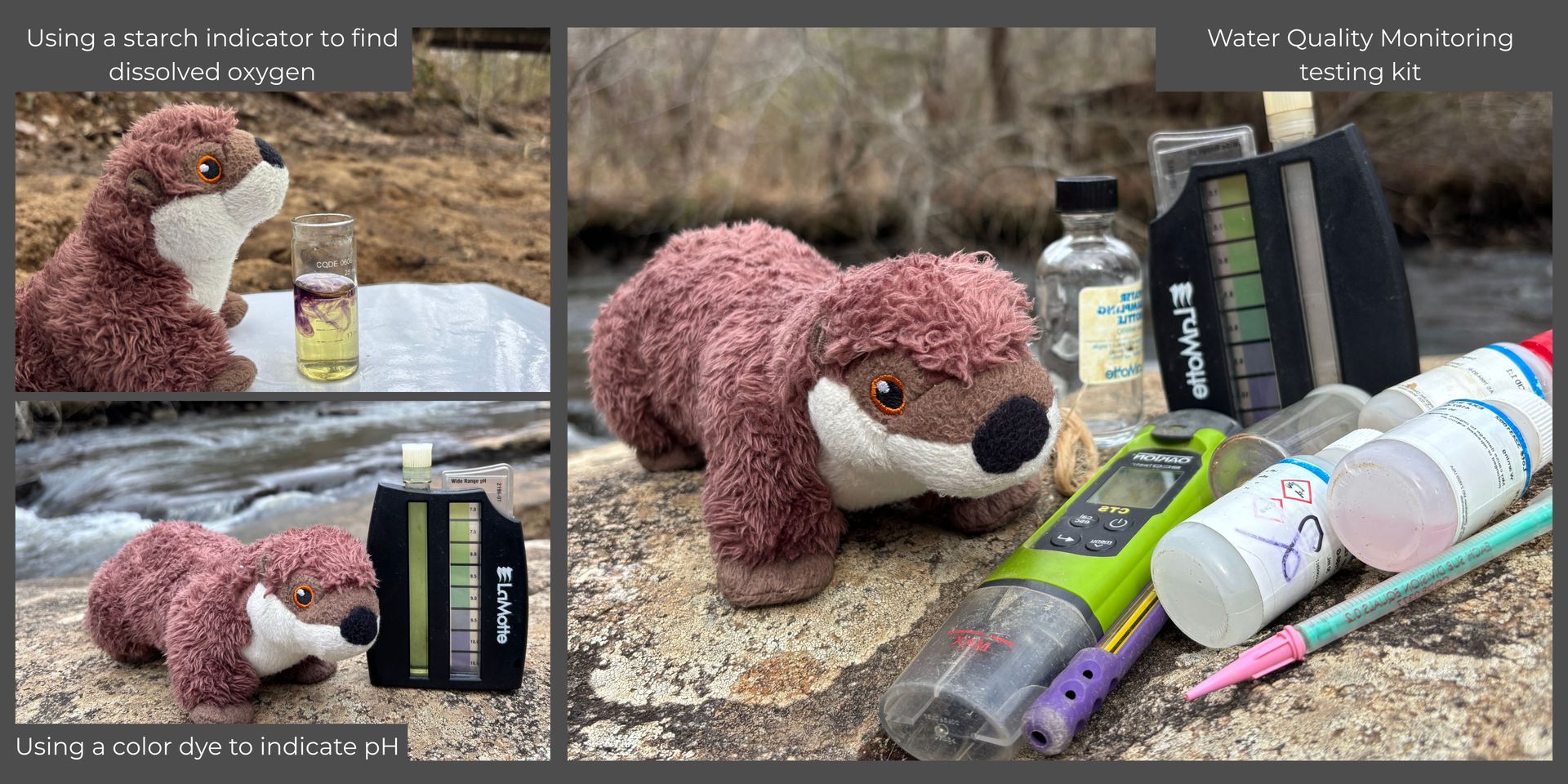
Recently, Flint the SCT river otter ambassador joined me in the field to help with our local water quality monitoring. We visited two sites along waterways that eventually flow into the Flint River: Line Creek and Flat Creek. Both of these sub-watersheds flow through several metro-Atlanta counties including Coweta, Fayette, Fulton, Meriwether, Spalding, and Troup. Flat Creek is an indirect tributary that flows into Line Creek, one of the major tributaries of SCT’s home watershed - the Upper Flint River.
While Georgia’s Adopt-A-Stream program can include chemical, bacterial, macroinvertebrate, visual, and/or amphibian monitoring, four members of SCT staff are currently trained to do chemical testing only. Every month, we collect data on site conditions that include air temperature, water temperature, pH, dissolved oxygen, and conductivity. By collecting the same data every month at the same site location, time of day, and around the same day each month, we will notice if there is a drastic change that could indicate a water quality issue (like a sewage leak or pollution runoff from an industry).
Community science initiatives, like your state’s Adopt-A-Stream program, empower everyday people to actively engage with nature and their community, while also making science more accessible. By involving volunteers in data collection and observation, community science initiatives expand the scale of research projects beyond what professional scientists could accomplish alone. Community science also strengthens public understanding of scientific methods, fosters critical thinking, and encourages informed decision-making on local issues.
As Flint learned, community science transforms curiosity into collective action, generating knowledge that benefits both your local community and beyond.
Press & Media Inquiries
Contact Us
About Southern Conservation Trust
At Southern Conservation Trust, we are passionate about elevating nature through exceptional stewardship. Based in Georgia, our 501(c)(3) public charity has successfully conserved over 65,000 acres of land across the Southeast, including five public nature areas in Fayette County and the Fayette Environmental Education Center. We believe that protecting our natural spaces is just the beginning; everyone should have equal access to enjoy the beauty of the outdoors. Join us in our mission to foster a deeper connection between people and nature. Learn more at www.sctlandtrust.org.
Share Post
Recent Articles & Blogs